

The Role of Atmospheric Planetary Waves in the Day-to-Day Variability of the Ionosphere
- The Role of Atmospheric Planetary Waves in the Day-to-Day Variability of the Ionosphere
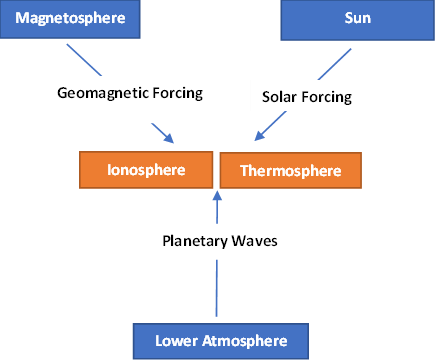
The aim of this project is to investigate how frequently planetary waves impact the ionosphere as well as examine if there are clear and repeatable patterns that may provide insight into the mechanism driving the atmosphere-ionosphere coupling.
The Ghost in the Machine: How Earth’s “Bottom” Atmosphere Disrupts the Edge of Space
For decades, scientists have known the ionosphere, the layer of our atmosphere that makes long-distance radio and GPS possible, is a chaotic environment. Most assumed the sun was the primary culprit for this turbulence. However, a groundbreaking 20-year study just revealed a surprising truth: the Earth itself is “screaming” at the edge of space. Large-scale planetary waves rising from the lower atmosphere are the secret drivers behind the ionosphere’s day-to-day mood swings, acting as a bridge between our weather on the ground and the harsh environment of outer space.
The Rhythm of the Sky
By analyzing two decades of NASA satellite data, researchers found that the sky has a pulse. Specifically, 3-day and 6-day “planetary waves” are so powerful that they dictate up to 92% of the oscillations seen in the ionosphere. While 2-day waves are more elusive, appearing and disappearing with the seasons, the 6-day waves are almost entirely independent of the sun. This means that even when the sun is quiet, the ionosphere is dancing to a beat generated by winds and heat cycles deep within our own troposphere.
Why This Matters for the Future
This isn’t just a win for atmospheric physics; it’s a vital discovery for our high-tech world. Understanding these internal “rhythms” allows us to better predict disruptions in GPS accuracy and satellite communications that occur even when there are no solar flares in sight. By identifying that wave amplitude and solar cycles change how these waves “hit” the ionosphere, we are one step closer to forecasting space weather as accurately as we do a summer rainstorm.
Curious about how these invisible waves shape our world?
Read the Full Study Here